
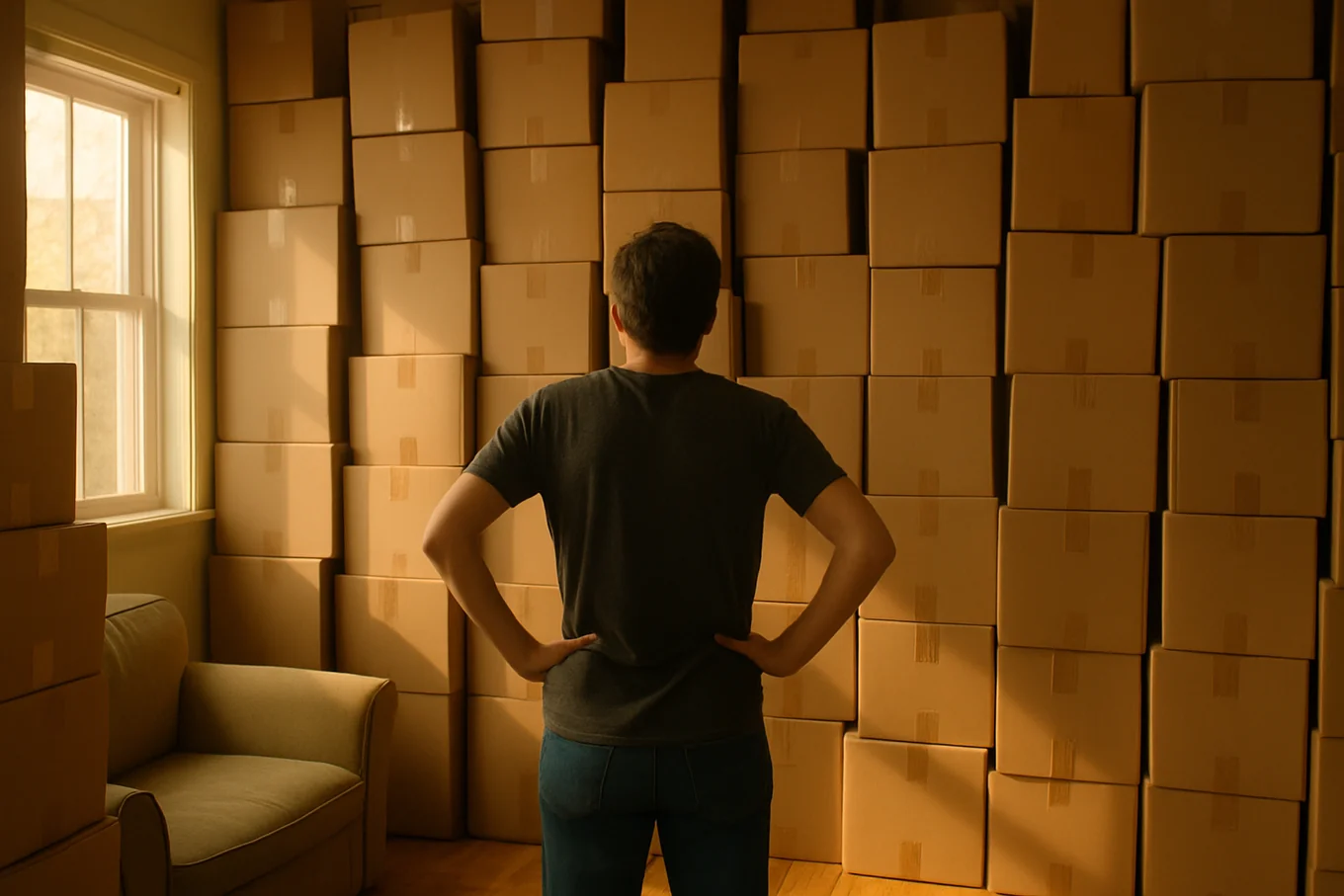
Why "I'll Remember Which Box Has the Coffee Maker" Is Always a Lie
Every person who has ever moved has said some version of it. "The towels are in the blue bin." "Chargers are all in that one box — I labeled it." "I'll definitely remember where I put the shower curtain rings."
Then moving day ends and you're standing in your new kitchen at 9 PM, exhausted, unable to find the box with the mugs — despite being absolutely certain you had a system.
This isn't a willpower problem or an organization problem. It's a cognitive one. Understanding why it happens is the first step to moving without losing your mind.
Your Brain Was Not Built for 200 Boxes
Working memory — the mental workspace where you hold active information — can manage roughly four to seven distinct chunks at once. That's fine for a grocery run. It is not fine for relocating a household.
A typical move involves somewhere between 50 and 250 boxes. Multiply that by decisions: what's inside, which room it came from, which room it's going to, whether it's fragile, whether it needs to be accessed early. That's hundreds of interrelated data points you're trying to hold in a system that was never designed for this.
The confidence you feel when you say "I'll remember" isn't evidence that you will. It's a feature of how memory works — we confuse the strength of an intention with the reliability of recall. The coffee maker feels vivid right now because you just packed it. Try recalling where it is four days later, after you've packed 40 more boxes, argued with a moving company, slept poorly, and navigated a lease signing.
Labels Alone Don't Cut It
The standard advice is to label your boxes. Labels are better than nothing — but labeling has its own failure modes that rarely get discussed.
Labels only answer "what room" — not "what item"
Writing "Kitchen" on twelve boxes tells you approximately nothing when you need the colander at 7 AM on day two. You still have to open every kitchen box until you find it. Labeling by room reduces the search space; it doesn't eliminate the search.
Labels don't survive chaos
Boxes get flipped. Labels end up facing the wall. In the back of a moving truck, under four other boxes and turned backward, your beautifully labeled box might as well be blank.
Labels don't communicate priority
Which of the twelve kitchen boxes has what you need on day one versus what you won't touch for six weeks? Without a system that tracks priority, you end up unpacking everything just to find the one item you needed immediately.
What Actually Works: Item-Level Tracking
The difference between a stressful move and a manageable one is almost always information architecture — not physical organization, but information organization.
Moves that feel smooth share a common trait: someone kept a running record of what went where, not just a label on a box. In practice, that means:
- Each box has an ID (even just a number)
- Items are logged against that box ID
- Priority or category tags are applied ("first night," "fragile," "storage only")
- The record is searchable — so you can ask "where is the coffee maker" and get an answer in seconds rather than minutes
This sounds like a lot of work. In practice, logging takes five to ten seconds per item, and the time saved during unpacking is enormous — especially for the high-anxiety searches that happen when you've just moved in and nothing feels settled yet.
The Unpacking Phase Is Where Memory Fails Hardest
The real cost of a bad packing system isn't during the move. It's during unpacking, which is slower, messier, and more stressful than anyone expects.
Unpacking happens in pieces. You do the bedroom. You stop. You do the kitchen. You run out of energy. Weeks later, boxes are still sitting in the corner of the office, and you have a vague sense that one of them holds something important — but you can't remember what.
Without an item-level record, you eventually do one of two things: tear through every remaining box in a frustrating triage session, or leave them until necessity forces you to deal with them. Neither is a good option.
With a proper tracking system, you can look up exactly what's in the remaining boxes and make intelligent decisions about what to prioritize.
Using an App Removes the Paper Problem
Paper lists feel like the obvious solution — and they work, right up until you lose the paper, spill something on it, or realize you've made three separate lists that need to be reconciled.
A dedicated moving tracker handles all of this natively. TidyMove, for example, is built specifically around the box-and-item tracking workflow: assign items to numbered boxes, add notes, and search your inventory from your phone. The search feature alone justifies the effort of logging — when you need something at 11 PM on moving night, you're not flipping through a clipboard, you're typing two words and getting an answer.
Phone-based tracking also travels with you. The record lives in your pocket, accessible at the storage unit, in the truck, or in the new house — wherever the question comes up.
The Move You'll Actually Remember Well
Most people treat moving like a temporary chaos state they just have to survive. To some extent, that's true. But the difference between controlled chaos and genuine disaster usually comes down to documentation.
The best movers — people who've done it many times, or who've relocated large households professionally — aren't smarter or more organized than you. They've learned, often the hard way, that memory is unreliable under stress. So they stopped trusting it and started writing things down.
You don't need to be a minimalist or a professional organizer to move well. You just need a system that doesn't rely on you remembering where the coffee maker is at the end of the longest day of the month.
Your memory will thank you for not asking it to do this alone.