
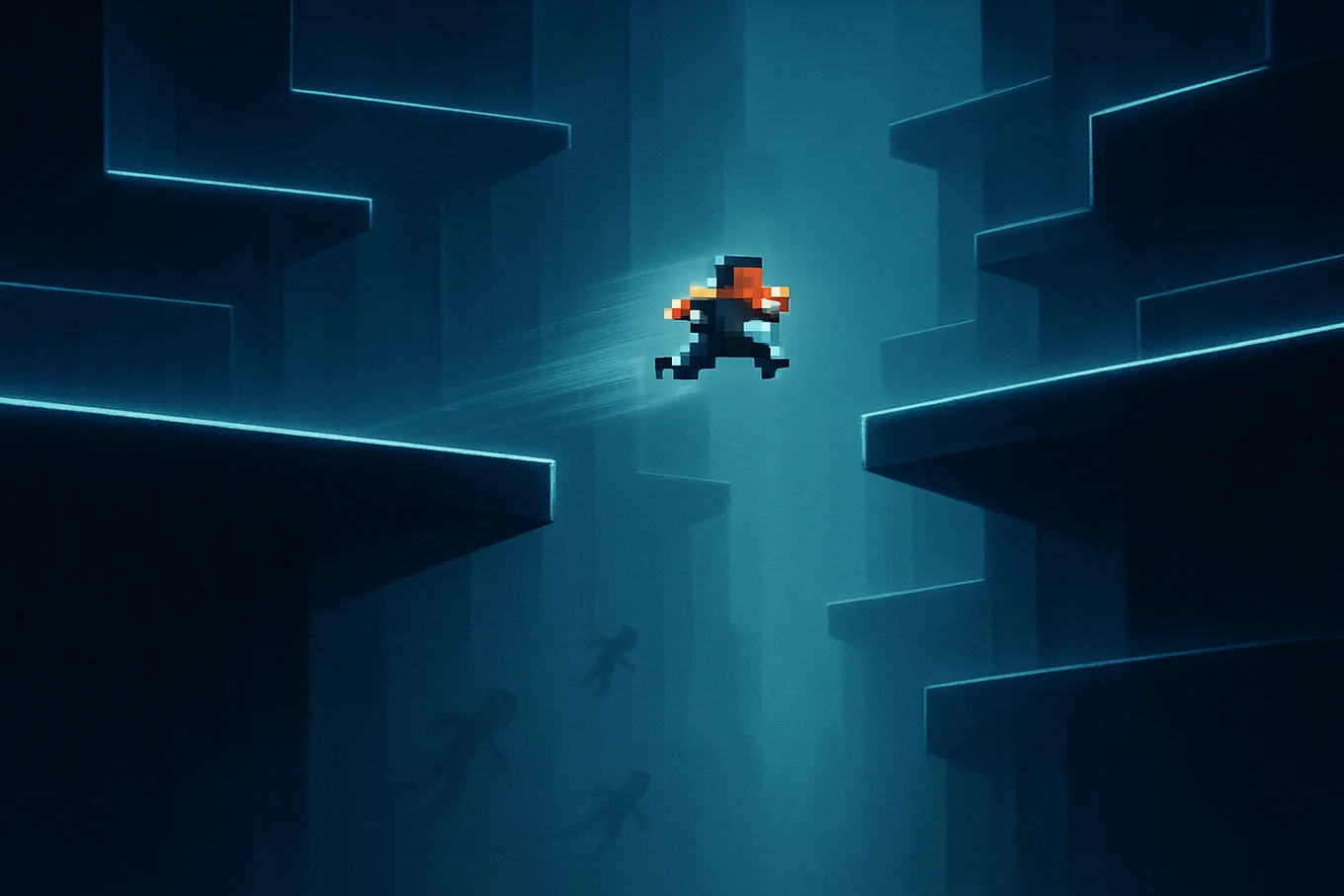
The "Widowmaker" of Mobile Gaming Is a Precision Platformer — And That's Exactly the Point
In skiing, the Widowmaker run doesn't care how confident you felt at the top of the lift. In professional kitchens, hollandaise doesn't care that you've made a thousand sauces before it. Every serious discipline has one — the thing that strips away pretense and shows you exactly where you stand.
Mobile gaming has its Widowmaker too. It's the precision action platformer.
Why Precision Platformers Are the Most Honest Games on iOS
Most mobile games are engineered around generosity. Lives regenerate. Difficulty curves soften if you fail too many times. The genre is built to feel good even when you're not particularly skilled at it.
Precision platformers reject that entirely.
When you miss a jump, you miss it because your thumb was 40 milliseconds late or your read of the gap was wrong. The game isn't being cruel — it's being exact. Every death is a data point. It's an honesty most mobile games actively avoid.
That's what makes the genre the Widowmaker of mobile gaming. It will tell you, clearly and repeatedly, what you can and can't do yet. For players who take iOS games seriously, that honesty is the whole appeal.
Hard vs. Punishing by Design — There's a Real Difference
A lot of games call themselves difficult. Fewer are actually designed that way.
Hard games can still be sloppy — vague hitboxes, inconsistent physics, obstacle placement that reads as random rather than deliberate. That's hard in the annoying sense. Punishing by design is something else: every platform placed with purpose, every frame of animation mattering, the difficulty emerging from the gap between where the player is and what the game demands.
This philosophy has deep roots in the indie scene. Celeste, Super Meat Boy, N++ — these games built communities around the idea that dying hundreds of times isn't a failure state. It's the experience. The skill is the destination, and each death is a step on the path there.
On iOS, this approach is genuinely rare. The platform's casual history, short session expectations, and touchscreen input constraints make it hard to build a precision platformer that holds up. Most developers don't try. The ones that do, and get it right, are immediately recognizable.
The Real Design Problem: Making Precision Work on Glass
Translating precision platforming to a touchscreen is a hard design problem with no perfect solution — only considered trade-offs. The challenges are concrete:
- Input timing: Even a 16ms delay between tap and response can break the muscle memory that precision jumps depend on.
- No tactile confirmation: Physical buttons give unconscious feedback that your input registered. Glass doesn't.
- Thumb coverage: Your fingers sit over part of the screen during play, often obscuring exactly what you're trying to navigate.
Games that genuinely solve these problems — through tight engine work, deliberate control layout, and level design that accounts for how people actually hold a phone — earn the precision platformer label. Games that ignore these constraints and just claim the name are a different product entirely.
The control scheme isn't a UI detail. It's a fundamental statement about what kind of game you're building.
The Skill Ceiling Is the Point, Not the Problem
The most common criticism of difficult mobile games is that high skill requirements are exclusionary — that they lock players out instead of welcoming them in.
This misreads what these games are for.
A high skill ceiling isn't a wall. It's a destination. Every time you clear a sequence that stopped you cold yesterday, every time the muscle memory clicks and your thumbs execute what your mind once had to consciously plan — that's the payoff. The difficulty is the design. The game was always leading you here.
Platformer players understand this intuitively. The genre has always attracted people who treat failure as information rather than insult. The question for iOS has always been whether there's a game worth building that skill for.
Pavel Quest Premium and the Case for Serious iOS Platformers
This is exactly the space that Pavel Quest Premium occupies. The mobile landscape gives action platformers two default options: soften the difficulty until the genre label barely applies, or port a console experience onto a platform it wasn't designed for. Pavel Quest does neither. It's built for iOS specifically — not transplanted to it.
The precision is the premise. The game isn't reaching for the widest possible audience by lowering what it asks of players. It's built for people who take platforming seriously as a skill, who've run out of iOS games that actually challenge them, and who want something that respects their reflexes enough to demand they use them.
That's a specific audience. It's also an underserved one.
Why the Mobile Indie Scene Keeps Overlooking This Audience
The iOS indie platformer scene is underrated in part because the App Store's discovery mechanics have historically favored free-to-play titles with high install counts over premium games with engaged, returning players.
But that audience exists, and it's growing. Players who bought a high-end iPhone for the screen and the processing power, who have no interest in another gacha loop, who want something with actual depth — they exist. The disconnect is discoverability, not demand.
Precision platformers suit this audience structurally. The genre rewards replays naturally, punishes coasting, and delivers clear feedback on skill progression without needing monetization systems to sustain engagement. You come back because you want to get better. Getting better takes real time. That's a value proposition that works for premium indie games in a way it doesn't for casual titles designed around daily check-ins.
The Test
The simplest test: if a mobile game would be equally enjoyable to a player who never improves, it's not actually a precision platformer. It's something else wearing the genre's label.
A real precision platformer should have a Widowmaker moment — a point where the gap between current skill and what the game requires becomes visible. The best players in the genre will tell you plainly: that wall is what they came for. Breaking through it is the game.
Mobile gaming has spent years treating accessibility and depth as opposites. They aren't. But serving players who want depth means building for them deliberately — from control design to the placement of the first platform. Not as an afterthought. Not with a difficulty slider bolted on afterward.
The precision action platformer on iOS is the answer to a question the platform has mostly avoided asking. The games that get it right are worth finding — and worth every death it takes to clear them.