
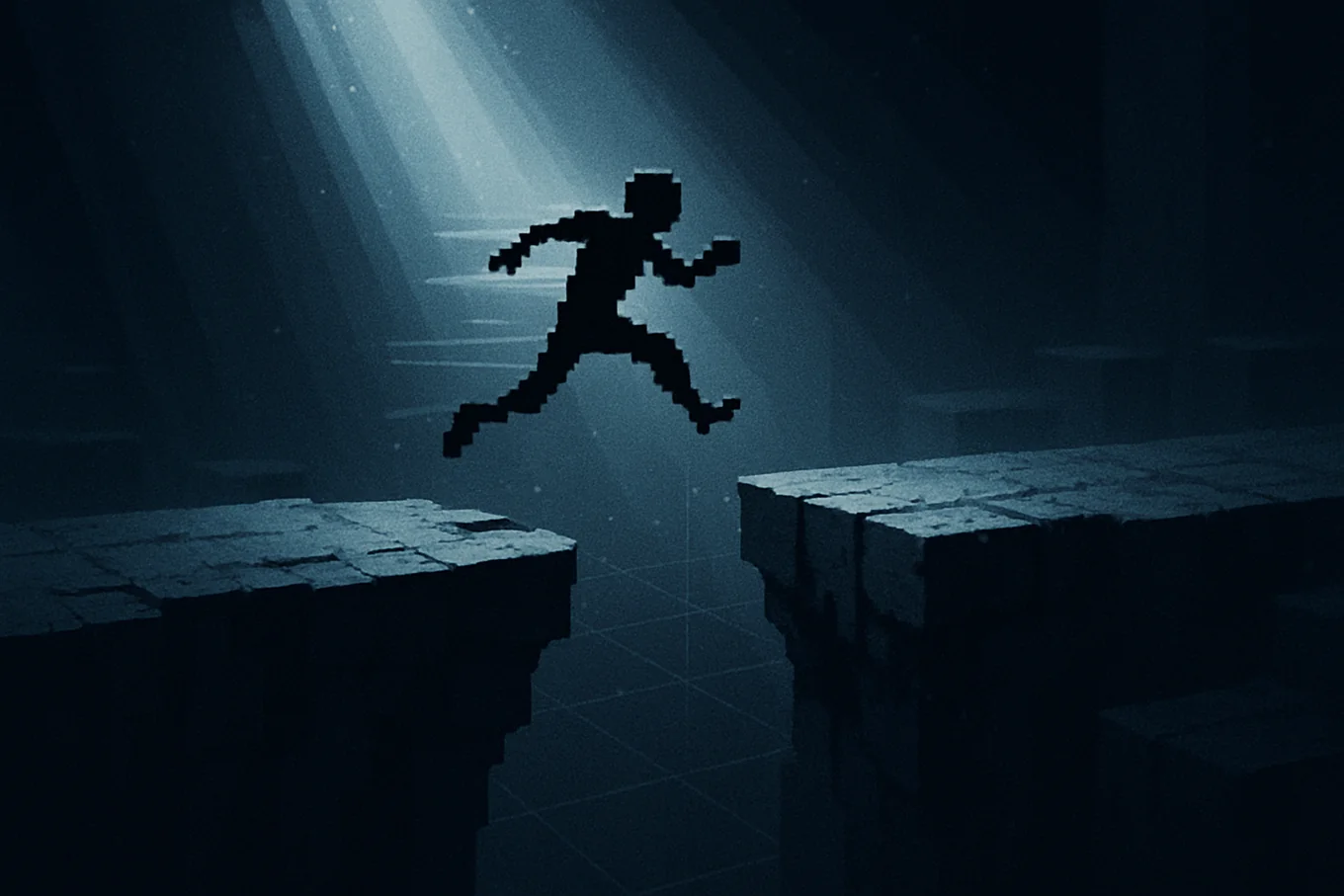
Why the Best Platformer Games Make You Play Their Way (And Why That's a Good Thing)
There's a well-worn debate in gaming circles: should a game bend to the player, or should the player bend to the game? A discussion making the rounds this week revived the classic complaint about games that quietly — or not so quietly — force you to play exactly the way the developers intended: invisible walls, forced camera angles, enemies placed so you have to learn the dodge. For most genres, this feels like a constraint. For precision platformers, it's the whole point.
Precision platformers take this philosophy to its logical extreme, and the best ones on iOS have turned it into an art form. Here's why tight, uncompromising design isn't a flaw in action platformers — it's the feature.
What Actually Makes a Platformer "Precision"
Not every platformer with difficult jumps earns the precision label. The word gets thrown around loosely, but genuine precision platformers share a specific design contract with the player: the controls are pixel-perfect, the hitboxes are honest, and every death is traceable to a mistake you made — not a mistake the game made.
That's a harder standard to meet than it looks. A game where you die because of a janky physics interaction or an imprecise jump arc isn't hard — it's broken. A game where you die because you timed the wall jump 80 milliseconds too late, and you know it, and you immediately try again? That's precision. The distinction matters enormously, because it's the difference between frustration and compulsion.
Why Tight Design Constraints Create Better Experiences
When a precision platformer forces you to play a specific way, it's making a promise: master this, and it will feel incredible. The constraints aren't arbitrary — they're load-bearing. Every obstacle is tuned to teach a mechanic. Every checkpoint is a deliberate decision about when you've earned a breath. The game is a series of skill gates, and clearing each one carries genuine weight.
Compare this to open-ended platformers that let you cheese your way through sections. Speedrunners of those games get a dopamine hit from a perfect skip, but casual players often feel oddly hollow after finishing. When you haven't been asked to meet the game on its terms, clearing it doesn't mean much. Precision platformers deny you that exit — which is precisely why nailing a brutal section feels so good.
This philosophy defines the best indie platformers on mobile right now. A tight action platformer has to be deliberate about everything: jump height, coyote time, input buffer windows, enemy patrol patterns. Each parameter either serves the experience or undermines it. There's no hiding behind procedural generation or open-world padding.
What Separates Great Precision Platformers from Punishing Ones
The genre has earned a reputation for cruelty, and some titles deserve it. But the genuinely great ones understand something important: the goal isn't to make you feel bad. It's to make you feel capable. There's a meaningful difference between a game that kills you to teach you something and a game that kills you because it can.
The markers of a well-designed precision platformer:
- Instant respawns. Every second of load screen between death and retry chips away at momentum. The best games get you back in immediately.
- Readable death states. You should always know, at a glance, exactly what killed you and why. Ambiguity is the enemy of learning.
- Incremental challenge. The difficulty curve should feel like climbing stairs, not hitting a wall. Each new mechanic is introduced cleanly before it gets layered with others.
- Honest hitboxes. If the sprite says you made it, you made it. If it says you didn't, you didn't. No phantom deaths, no ghost hits.
- Expressive movement. The best precision platformers give you tools that feel good to use — a jump with a satisfying arc, a dash that pops. The physicality is part of the reward.
Why Mobile Is the Perfect Platform for This Genre
There's a persistent myth that precision platformers don't belong on touchscreens. The argument is that virtual buttons lack the tactile feedback needed for split-second inputs. It's a reasonable concern — and one that well-designed mobile action games have been quietly dismantling for years.
The most elegant solution isn't to replicate console controls on glass at all. Some of the best mobile precision platformers strip the interface down to almost nothing, building their entire control scheme around a single tap. No virtual d-pad to drift off, no buttons to miss — just the screen and your thumb. That kind of minimalist input design forces the level design to do more work, and when it's executed well, the result feels cleaner than a port of anything.
Done right, a precision action platformer on iOS works for ten minutes on a commute or two hours in a sitting. The session structure suits mobile perfectly: short, repeatable challenges that reward mastery over time. You don't need to reconstruct a complex save state or re-establish context every time you pick it up. You just play.
If you're looking for a precision platformer that takes mobile controls seriously, Pavel Quest Premium is worth your time. It's an iOS action platformer with no virtual buttons whatsoever — you tap the screen to jump, and that's it. The entire game is built around that single input, which means every ounce of design attention went into making that tap feel exactly right.
The Bottom Line
The philosophy of making players adapt has a bad reputation — earned by games that use it as cover for bad design. But in precision platformers, that uncompromising approach is the point. When a level has only one right path through it, clearing it means you found that path — not that you stumbled through it. The constraint is the craft.
The best indie platformers on iOS right now understand this. They're not hard for the sake of being hard. They're hard because they respect your ability to improve, and they've designed every obstacle to prove them right. That's a rarer quality than it sounds — and it's exactly what keeps the genre's most devoted players coming back.